The Anatomy of Legal Insanity: Inside the Lindsay Clancy Trial and Massachusetts’ McHoul Standard

Inside the Lindsay Clancy Trial and Massachusetts’ McHoul Standard
Plymouth County, MA-The high-profile murder trial of Lindsay Clancy in Plymouth Superior Court has drawn national attention to the complex intersection of severe mental health crises and the legal definition of criminal responsibility.
On January 24, 2023, the 36-year-old former labor and delivery nurse from Duxbury, Massachusetts, strangled her three children—5-year-old Cora, 3-year-old Dawson, and 8-month-old Callan—with exercise resistance bands before jumping from a second-story window in a suicide attempt that left her permanently paralyzed.

The physical facts of what occurred are uncontested by both sides. Instead, the trial centers entirely on a single question: was Clancy legally sane and criminally responsible at the exact moment the killings took place?
The central conflict in the courtroom illustrates a critical distinction that frequently causes public confusion: the difference between medical mental illness and legal insanity.
Medical Illness vs. Legal Insanity
In general conversation, terms such as “snapping,” “mental breakdown,” or “psychotic episode” are often used to describe severe psychological distress. Within the judicial system, however, a clinical psychiatric diagnosis does not grant automatic immunity from criminal prosecution.
A defendant can suffer from profound mental illness, severe depression, or suicidal ideation while remaining legally responsible for a crime. Legal insanity is a precise legal threshold that measures cognitive understanding and behavioral control during a specific window of time, rather than a general medical status.
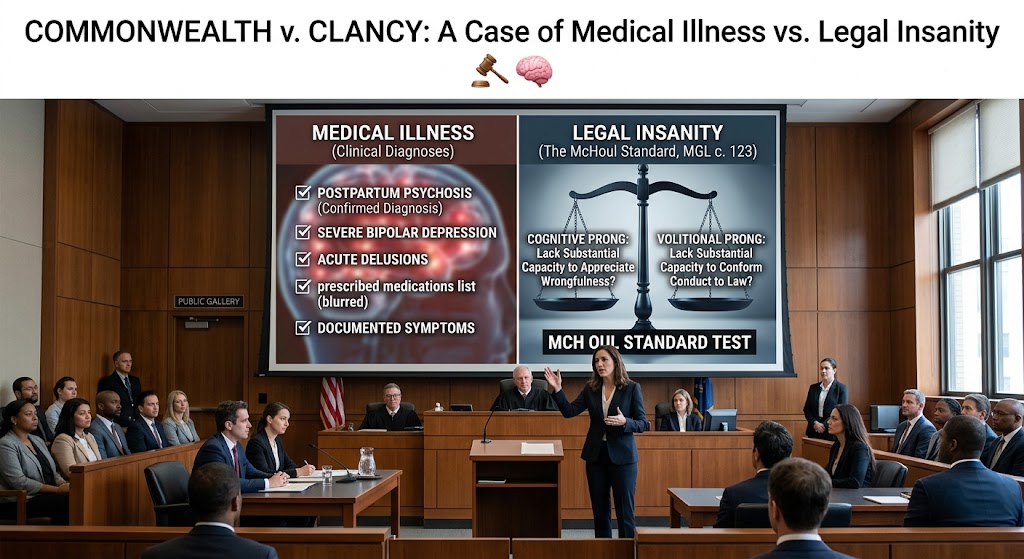
The McHoul Standard in Massachusetts
Massachusetts evaluates criminal responsibility using the McHoul standard (Commonwealth v. McHoul, 1967). Under this rule, a defendant is judged not criminally responsible if, at the time of the offense, a mental disease or defect caused them to lack “substantial capacity” in either of two prongs:
- The Cognitive Prong: The capacity to appreciate the criminality or moral wrongfulness of their conduct.
- The Volitional Prong: The capacity to conform their conduct to the requirements of the law.
Unlike older legal definitions that required a complete absence of reason, McHoul examines whether a diagnosed psychiatric condition impaired an individual’s mental capacity so severely that they could no longer understand the wrongfulness of their actions or exercise self-control.
Prosecutorial Strategy vs. Defense Arguments
Because Massachusetts law requires the prosecution to prove legal sanity beyond a reasonable doubt once the defense presents evidence of insanity, the trial features two opposing interpretations of Clancy’s mental state:
The Defense Arguments
The defense frames Clancy as a loving mother caught in a severe, escalating psychiatric crisis. Defense counsel outlines a months-long effort to seek medical help, including multiple outpatient visits, emergency room admissions, a stay at a psychiatric hospital, and a rotating sequence of prescribed psychiatric medications. The defense contends she suffered from undiagnosed bipolar disorder and acute postpartum psychosis, arguing that she acted under command hallucinations that completely destroyed her ability to comprehend the moral reality of her conduct or stop her actions.
The Prosecution Arguments
The prosecution focuses on evidence of executive functioning, timing, and goal-directed behavior. Prosecutors point to her actions on the day of the killings, including using mapping applications to calculate the time required for her husband to pick up dinner and medication from a nearby town, thereby creating an uninterrupted period alone in the house.They also highlight her digital records—such as phone searches regarding suicide methods, psychiatric treatments, and drug side effects—arguing that these reflect deliberate planning, rational thought, and an awareness of wrongfulness rather than an unguided, involuntary impulse.
Jury Evaluation and Legal Outcomes
Under Massachusetts jury instructions, jurors are the sole triers of fact and are not obligated to accept expert psychiatric opinions blindly. They are instructed to weigh expert medical testimony against physical evidence, including phone logs, text messages, and witness accounts.
If the jury returns a guilty verdict on first-degree murder charges, the conviction carries a mandatory sentence of life in prison without the possibility of parole. Conversely, if the jury finds her not criminally responsible by reason of insanity, Clancy will not be released; she will instead be committed to a state psychiatric facility for custody and ongoing treatment, subject to periodic judicial review.
The trial demonstrates the strict boundary maintained by the legal system: courtrooms do not measure the intensity of an individual’s mental suffering, but whether that suffering rendered them incapable of understanding right from wrong or controlling their behavior when the act was committed.
[simple_poll id=”5″]