

ALERT: Inside the Fake Town Permit & Zoning Invoice Scam Targeting Plymouth County

A sophisticated, highly targeted fraud scheme is actively hitting property owners,
contractors, developers, and local attorneys across Plymouth County and the South Shore. The Town of Plymouth, neighboring municipalities like Scituate, and the Massachusetts State Police Commonwealth Fusion Center have all issued urgent warnings about fake municipal invoices demanding thousands of dollars in fraudulent permit and zoning fees.
Unlike typical spam emails sent out to millions of random addresses, this operation relies on public municipal data and careful timing—making the scam convincing enough to fool experienced builders, real estate professionals, and everyday homeowners alike. Here is a complete breakdown of how the scheme operates behind the scenes, why it works so well, and the exact steps you need to take to protect your money.
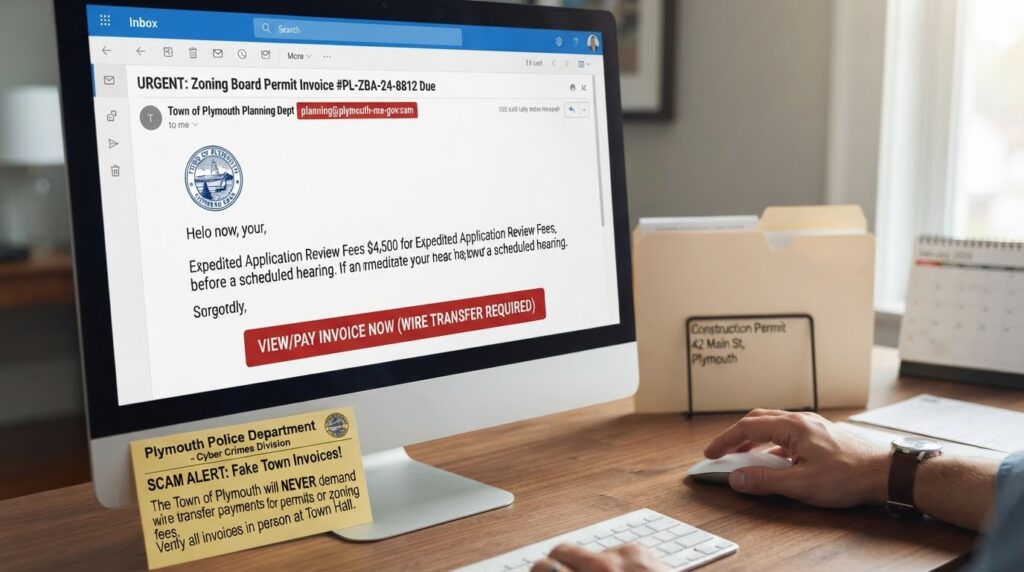
How the Scam Operates Behind the Scenes
Phase 1: Automated Scraping of Public Town Records
Under Massachusetts open-meeting and public-records laws, local Planning Boards, Zoning Boards of Appeals (ZBA), and Conservation Commissions are required to post upcoming meeting agendas, public hearing notices, and permit applications online.
Fraudsters use automated scraping software and AI tools to continuously monitor municipal websites across Plymouth County. The moment a new agenda or public notice is uploaded, the scammers extract a complete profile of the project:
- The full legal name of the homeowner, developer, or LLC.
- The exact street address, lot number, and parcel ID of the property.
- Official municipal docket, case, or permit numbers.
- The specific variance, special permit, or site plan approval being requested.
- The names of the applicant’s project team, including surveyors, engineers, architects, and local land-use attorneys.
Phase 2: Building a Spoofed Municipal Identity
Next, the scammers look up the public staff directory on the town’s website to find the real names and job titles of local planners, zoning administrators, and department clerks. They copy the official town seal, standard municipal email signature blocks, and formal bureaucratic formatting.
To bypass a quick visual check, they register “lookalike” internet domains that closely mimic official government addresses—for example, using @plymouth-ma-gov.com, @townofplymouth-permits.org, or @plymouthzoning.com instead of the town’s actual .gov domain. On a smartphone screen, where email apps often hide the full sender address and display only the sender’s name, the message looks indistinguishable from a real email sent by Town Hall.
Phase 3: Psychological Timing and the “Approval Trap”
Scammers do not send these emails randomly. They wait until just a few days—or sometimes just hours—before a scheduled public hearing, knowing that applicants have already invested significant time and money and are anxious to avoid any last-minute delays.
The email usually delivers welcome news: town staff have completed their review of the application and are recommending approval, contingent upon the immediate payment of an administrative balance. Common excuses include unpaid “public hearing notice fees,” “engineering peer-review deposits,” “application processing balances,” or “final recording fees.” Attached is a clean, professional PDF invoice featuring the town logo, the applicant’s real property address, and the exact docket number from the town agenda.
Phase 4: Blocking Traceable Payments
The defining red flag happens when the victim tries to pay. If the applicant replies asking to drop off a paper check at Town Hall or pay via credit card on the town’s official online portal, the scammer responds rapidly with a plausible excuse—claiming the online portal is undergoing maintenance, that checks take too long to clear before the board vote, or that wire transfer is required for that specific fee category.
They then provide routing and account numbers for a domestic “mule” bank account or money-service business. Once the victim initiates the wire transfer, the funds are immediately moved overseas, making recovery nearly impossible.
How to Spot the Scam and Protect Yourself
1. Check the Exact Domain Extension
Every official email from the Town of Plymouth ends strictly in @plymouth-ma.gov. Other Plymouth County towns use their own official .gov or .us municipal domains. Any email claiming to be from a town department that ends in .com, .org, or .net—or adds extra hyphens and words like -permits or -gov—is a guaranteed scam. Tap or click directly on the sender’s display name to reveal the full underlying email address.
2. Treat Wire Transfer Requests as Automatic Fraud
The Town of Plymouth and surrounding South Shore municipalities never demand wire transfers, ACH transfers to third-party accounts, cryptocurrency, or payment apps for zoning, planning, or building permit fees. Legitimate municipal fees are paid only in person at Town Hall by check, cash, or card, or directly through the town’s verified payment portal.
3. Use “Out-of-Band” Verification
Never hit “Reply” on an unexpected invoice email, and never call a phone number printed inside a suspicious PDF invoice—scammers frequently staff fake phone lines to reassure hesitant callers. Instead, open a fresh browser window, go directly to the official town website (plymouth-ma.gov), look up the Planning, Zoning, or Building Department phone number independently, and call the clerk directly to verify if you owe a balance.
4. Lock Down Communication With Your Project Team
If you have an active permit, variance, or subdivision filing pending, brief your contractor, engineer, architect, and real estate attorney immediately. Establish a strict rule that no one on your team wires funds or pays a municipal invoice on your behalf without verifying it first via a direct phone call to Town Hall.
5. Report Attempted Fraud Immediately
Even if you catch the scam before sending money, reporting the email helps local law enforcement and state fusion analysts track the domains and bank accounts being used. Forward suspicious invoices and report attempts to:
- Your Local Police Department (non-emergency line)
- Town of Plymouth IT Help Desk: 508-747-1620, ext. 10411
- Massachusetts State Police Commonwealth Fusion Center: 508-820-2233
Donate to Plimoth Today
Help sustain Plimoth & local Plymouth County news. Empower community journalism today!