Ground Settling and Sinkhole Prompt Evaluation at Plymouth Water Street Sewer Site

PLYMOUTH, Mass. — The Water Street sewer replacement project faces new site evaluation following routine monitoring that revealed structural settling at the Plymouth Waterfront Visitor Center and a sinkhole in an adjacent parking lot.
During scheduled survey measurements on Tuesday, Sept. 29, monitoring crews reported that the southeast corner of the visitor center, situated near the Water Street and Town Wharf rotary, had settled nearly 2 inches relative to previous baseline readings. On the afternoon of Friday, Oct. 2, a 3-foot-deep sinkhole emerged in the Memorial Hall parking lot directly behind the facility after a section of asphalt gave way.
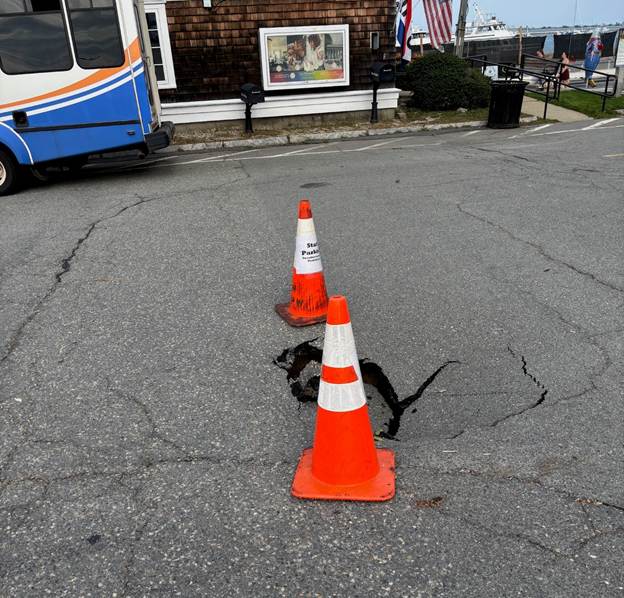
Out of caution, project officials temporarily suspended the operation of nine active dewatering wells on Oct. 2 to allow geotechnical engineers time to examine soil behavior. The well system, operated by general contractor Northern Construction, draws down groundwater levels to establish stable digging conditions. Prior to the pause, pumping had lowered the water table to approximately 16 feet below ground level, with an additional 7 feet of drawdown required before deep excavation could begin. Discharge water is processed through sediment filter tanks on Town Wharf prior to harbor release.
Department of Public Works Director William Coyle noted that officials are withholding conclusions on whether the rapid drawdown of groundwater directly contributed to local soil displacement until complete engineering analyses are finalized.
A ground-penetrating radar (GPR) survey is scheduled for Friday, Oct. 9, to scan subsurface conditions to a depth of 8 feet across the site. The radar sweep is designed to detect underground voids or unstable structural conditions, with a technical findings report anticipated within a week of scanning.
Because visual inspections indicate the area remains stable, municipal authorities authorized the restart of the dewatering pumps to mitigate schedule delays.
The active construction phase involves replacing the final 70-foot segment of a quarter-mile sewer interceptor installation. Work on this section was initiated after post-installation monitoring indicated that the original replacement pipe had settled beyond acceptable tolerances into soft soil layers. The overall municipal project replaces a 30-inch main originally constructed in 1969 to safeguard against potential environmental hazards along the waterfront.