
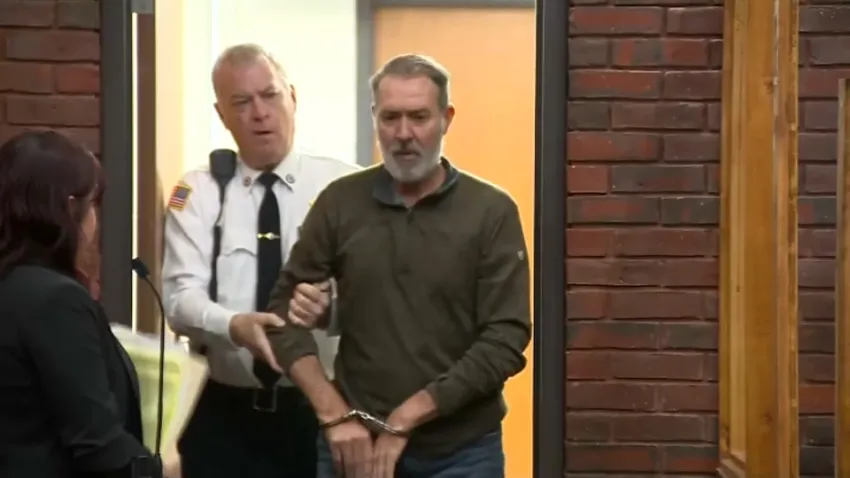
SPECIAL INVESTIGATION: IS AN INNOCENT MAN GOING TO THE CHOPPING BLOCK? THE BRADLEY REIN CASE
Hingham, Mass — As the legal battle over the 2022 Derby Street Shops tragedy stretches into its fourth year, a haunting question looms over the Plymouth County Superior Court: Is the justice system preparing to convict a man for a murder that was actually a mechanical and physical impossibility?
With the trial date now pushed to January 2027, Plimoth Today examines the conflicting evidence, the “black box” data at the center of the storm, and a defense strategy that points toward a systemic flaw in how Americans are taught to drive—and how cars are built to fail.
THE INCIDENT: A Routine Errand Turned Deadly
Bradley Rein, 53, entered the Derby Street Shops seeking a routine repair for a broken eyeglass lens. Minutes later, his 2019 Toyota 4Runner accelerated to 60 mph, hurtling through the front glass of the Apple Store. The crash resulted in one fatality and injured 22 others.
The core of the legal debate rests on five seconds of data that the prosecution claims proves murder, but the defense claims proves a nightmare beyond the driver’s control.
THE PROSECUTION: “Extreme Atrocity” and Digital Fingerprints
The Plymouth County District Attorney’s office elevated charges to Second-Degree Murder, arguing that Rein’s actions demonstrated a “depraved indifference to human life.” Their case is anchored by the vehicle’s Event Data Recorder (EDR).
The Evidence Ledger:
- The “Floored” Signal: EDR logs show the accelerator was at 100% capacity for five consecutive seconds.
- The Braking Gap: Data confirms the brakes were never engaged.
- Steering Logic: Prosecution experts highlight a deliberate left turn made just before impact, suggesting Rein was in control of the vehicle’s direction.
- Mechanical Soundness: State Police forensic mechanics testified they found no mechanical defects in the 4Runner’s systems.
THE DEFENSE: The “Pedal Swap” and Software Anomalies
Defense attorneys challenging the “murder” narrative by citing a phenomenon that affects thousands of drivers across the U.S. every year.
1. The Statistics of a “Pedal Crisis”
The defense intends to introduce national data to argue the crash was a physical and technological failure.
- National Frequency: The NHTSA estimates that pedal misapplication—pressing the gas when intending to hit the brake—causes roughly 16,000 crashes per year in the U.S.
- The Training Argument: Proponents of the “Left-Foot Braking” method argue that the U.S. standard of “Right-Foot Only” driving is a relic that leads to thousands of daily “near-misses” and entrapment incidents due to muscle-memory conflict during panic.
2. The “Stuck Foot” Theory
Rein’s primary defense is “Foot Entrapment.” He claims his right foot became wedged between the pedals, and while he tried to use his left foot to hit the brake, he was physically unable to stop. The defense argues the EDR recorded the result (100% throttle) but not the human intent (the panic of being stuck).
3. Challenging the Black Box
A critical part of the upcoming trial will be the forensic audit of Toyota’s “Drive-by-Wire” system. The defense is investigating if a software anomaly (a “bit flip”) could have commanded full throttle while simultaneously logging that command as a “user input” in the EDR.
BACKGROUND CHECK: Motive, Sobriety, and Past History
A key challenge for the prosecution is the total absence of traditional criminal indicators.
- No Prior Violent History: There is no documented history of domestic violence or assault on Rein’s record. Before this incident, his only significant interaction with law enforcement was a 2020 DUI charge in Vermont, which was reportedly expunged.
- Current Assault Charges: While he currently faces 18 counts of Aggravated Assault and Battery with a Dangerous Weapon, these are legal classifications for the crash injuries, not evidence of a violent past.
- Sobriety: Rein’s blood alcohol content was 0.00%. Investigators formally ruled out drugs and alcohol as factors within hours.
- Motive: No link was found between Rein and the Apple Store or its employees. He was quite literally a man on his way to fix his glasses.
THE ROAD TO 2027
The case now moves into a deep-dive forensic phase. A judge has granted the defense team time to conduct an independent analysis of the 4Runner’s firmware—a move that could have massive implications for automotive liability nationwide.
Case Status At-A-Glance:
- Charges: Second-Degree Murder, Motor Vehicle Homicide, 18 counts of Aggravated Assault & Battery.
- The Conflict: Digital data (Prosecution) vs. Human factor/Software reliability (Defense).
- Next Milestone: Expert software depositions scheduled for late 2026.
If the defense can prove that “pedal entrapment” or a software glitch is a reasonable possibility, it will raise the ultimate question: Are we about to send a man to prison for the failures of modern technology?
After the tragic crash at the in 2022, renewed attention has been placed on pedal misapplication crashes — incidents where drivers accidentally hit the accelerator instead of the brake. Advocates of left-foot braking argue that traditional right-foot-only braking methods may contribute to these types of accidents and are calling for more scientific research into alternative driving techniques.
Supporters point to studies and crash data involving unintended acceleration and pedal confusion, claiming thousands of pedal-error incidents occur annually across the United States. They say there has been little public research into whether left-foot braking could reduce reaction times or prevent certain crashes.
Organizations such as LeftFootBraking.org are urging transportation officials, researchers, and driving schools to conduct independent scientific studies rather than dismissing the idea outright. Some driving instructors and students have also reportedly expressed interest in learning different braking methods, though most U.S. driver education programs continue teaching traditional right-foot braking.
Traffic safety experts remain divided on the issue. Critics argue left-foot braking can increase the risk of accidental simultaneous braking and acceleration for untrained drivers, while proponents believe modern automatic vehicles may benefit from updated training standards.
Advocates say the discussion should focus on evidence, research, and crash prevention — especially following high-profile tragedies that raise questions about driver response times and pedal control.
Please share your perspective on this case in the comments section.”
About the Author







Unintentionally causing a death by performing a reckless act is involuntary manslaughter in our state. In this instance, even if the worst is assumed and the defendant accidentally jammed his foot down on the gas, there’s no reason to suspect it was a reckless act. There was no intoxication, no violation of traffic safety laws, no perceivable malicious intent and no known motive. I don’t think this even qualifies as involuntary manslaughter. However, it’s not up to me to judge this case based on a couple news articles (possibly written by AI!). My best wishes for everyone involved and my best hopes for a truly fair and just outcome.